

Coffee with Rema
☕️ The "Rambam of Poland" made the Shulḥan Arukh acceptable to Ashkenazi Jewry with his glosses, also creating original works of Halakhah and harmonizing Kabbalah with his rationalist interests.

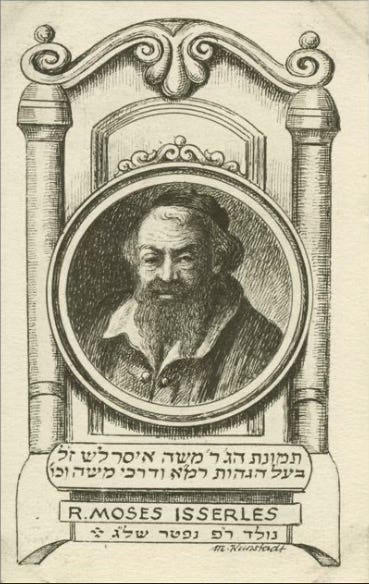
Hello, dear readers, it’s great to be back here with you after an unintentional hiatus: I’ve been doing some intensive work training for the past six months, which is just winding down. I’m excited to kick off the sequel to Coffee with the Rishonim today—Coffee with the Aḥaronim. As we’ve mentioned before in these (digital) pages, the dividing line that separates a Rishon and an Aḥaron is not as clear as it appears on the surface. But if we use the classical definition an Aḥaron as a Torah scholar working in response to the Shulḥan Arukh—or at minimum within the framework of a post-Shulḥan Arukh world—then certainly Rema must be the person with whom we begin. Rema, as we’ll see, began a project parallel to R. Yosef Karo’s, but from his Ashkenazi perspective. When he learned of the latter’s Beit Yosef, he became the first commentator on the galvanizing work of the Meḥaber, allowing for its acceptance throughout the Jewish world.
And yes—there are many Rishonim that I haven’t yet covered, as well as many Aḥaronim that will doubtless have to be left out of the series. I hope to be able to cover as many as possibly in due time!
In this issue:
Poised for Greatness
R. Moshe Isserles (c. 1525/30 - 1572), the Rema, was in many ways the Ashkenazi counterpart of R. Yosef Karo, whose figure would cast a long shadow over Rema’s achievements in the view of history. If R. Karo’s life was typical of the arc taken by Sephardi forced émigrés from Spain to Ottoman Turkey and finally to the Ottoman-held Land of Israel, Rema’s was typical of post-expulsion Ashkenazi Jewries, who migrated eastward into available areas in Central Europe and pushed into Eastern Europe. Rema’s great-grandfather had been the first rabbi appointed to the community of Brisk (Brest-Litovsk) in what is today Belarus, and he himself was born and worked in Kraków. Also like R. Karo, Rema was something of a prodigy, inclined towards consolidation and codification, swam naturally in the waters of Kabbalah, and was a preeminent authority in his time and place.
In his twenties, Rema was already serving in the capacity of dayan (community judge) in the Kraków beit din. Having concluded his studies in Lublin in the yeshiva of R. Shalom Shakhna, who effectively institutionalized advanced Talmud study in Poland (building on the work of his teacher, R. Yaakov Pollack, an early Polish halakhic authority), Rema returned to Kraków. There, his young wife—perhaps the daughter of R. Shakhna—died, sadly. To her memory, Rema dedicated the building of a synagogue that still stands, and is widely known as “the Rema Shul” (get a 360-degree look here).
Rema remarried and went on to profoundly shape generations of learning in Kraków and greater Ashkenaz. He founded a yeshiva and counted among his students a long list of Ashkenaz’s luminaries, including R. Mordechai Yaffe, author of the Levushim; R. David Gans, whose historical and scientific interests Rema encouraged; and R. Avraham ha-Levi Horowitz, father of R. Yeshayahu Horowitz, better known as the Shelah ha-Kadosh, an acronym for his work, the Shnei Luḥot ha-Brit. Rema produced reams of glosses on various texts reflecting his multifarious interests, from the Mordechai, a medieval Ashkenazi halakhic compendium, to Mizraḥi, the popular supercommentary on Rashi to the Torah. He also wrote a a halakhic monograph on Isur ve-Heter (the area of Halakhah that covers the laws of kashrut) called Torat ha-Ḥattat (The Laws of the Sin-Offering), following the rulings of the earlier Ashkenazi work on the topic, the Sha’arei Dura. This work received strident criticism by leading Ashkenazi scholars, while others came to its defense. Rema also wrote many responsa and works of philosophy, discussed below. Rema had a son and two daughters, both of whom married scholars; he great-granddaughter would marry the Shakh (Shabbtai ha-Kohen), author of the famed commentary Siftei Kohen on parts of Shulḥan Arukh.
Right Place, Wrong Time
Given this prestigious background and intellectual stature, it is not surprising that Rema positioned himself to write a definitive summation of Halakhah, conceived of as a commentary on the Arba’ah Turim of R. Yaakov ben Asher. If this choice sounds familiar, it’s because this is exactly the same choice R. Yosef Karo made at approximately the same time in the Land of Israel. The Arba’ah Turim (The Four Columns), better known simply as the Tur, is so called because of its quadripartite division of Jewish law into the daily and yearly rituals (Oraḥ Ḥayim), the other laws that commonly impact daily life (Yoreh De’ah), family law (Even ha-Ezer), and civil law (Ḥoshen ha-Mishpat). Like Rambam’s Mishneh Torah, R. Yaakov ben Asher’s schema was de novo, not based on the ordering of the topics in the Mishnah. However, it was highly pragmatic and left out laws not applicable to his contemporaries, such as rules governing the operation of the Beit ha-Mikdash (Jerusalem Temple), which Rambam had included in his code. So usable was the Tur that its schema would become the basis for rabbinic education, with community rabbis studying the topics covered in the first two sections, and court judges also the latter two sections.
That Rema, a great admirer of Rambam, also chose the Tur as the “hook” for his project, is telling. Not coincidentally, R. Yaakov ben Asher was the son of the R. Asher ben Yeḥiel, better known as the Rosh, who was a student of Maharam, a late Tosafist, in Germany. Fleeing political persecution, Rosh ended up with his family in Toledo, Spain. He and his son became important vectors of cultural transmission, particularly of Halakhah, from Ashkenaz to Sefarad. Perhaps for this reason too, as well as its practical approach, Rema found the work a good substrate for his summative, modificatory project of specifically Ashkenazi Halakhah.
When Rema learned that R. Yosef Karo had published a parallel work, the Beit Yosef, he put down his pen. Soon enough, he picked it up again and wrote in response to both the Tur and the Beit Yosef. What he titled Darkhei Moshe (today printed as a commentary to the Tur) would become preliminary to writing glosses (haggahot) to the Shulḥan Arukh, the summary of conclusions of the Beit Yosef that R. Karo was promulgating as a definitive guide to current Halakhah. The result, formally titled Ha-Mappah (The Tablecloth, i.e. to Shulḥan Arukh/The Set Table), is far more than just glosses. It is a careful, learned, and superbly distilled interweaving of centuries of Ashkenazi halakhic traditions into a Sefardi text. Rema’s glosses, for which he is best known, also played a decisive role in the standardization of Jewish observance by making one code acceptable to Ashkenazi and Sefardi Jews alike.
A Kabbalistic Philosopher
In addition to his halakhic activities, Rema was a systems thinker with a philosophical mind. Keenly interested in rational and secular subjects, including astronomy, history, philosophy, grammar, and textual criticism, Rema nonetheless was steeped in the Kabbalah, a prevalent aspect of Jewish thought among scholars, and increasingly the public, in early modernity. His major philosophical work, Torat ha-Olah (The Laws of the Burnt Offering) uses symbolism and analogy around the measurements of the Temple and the presentation of sacrifices to present semi-systematic conception of Judaism. Though presented with deliberate organization inspired by Rambam’s clarity, the work is much more figurative and traditional than the Greco-Islamic style of writing employed in Moreh ha-Nevukhim. It is also deeply Kabbalistic.
Rema’s Meḥir Yayin (The Price of Wine), in contrast, is a largely philosophical commentary on Esther. So to his To’afot Re’em, glosses on Rambam’s Moreh ha-Nevukhim and two prominent commentaries on it, those of R. Shem Tov Ibn Shem Tov and Profit Duran (Efodi). Rema produced solely scientific works as well, including a commentary on the fourteenth-century philosopher R. Yitzḥak Yisraeli’s astronomical work Yesod Olam. But two lost works that he mentions, a commentary on the Zohar and a systemic work on Kabbalah, Yesodei Sifrei ha-Kabbalah (The Foundations of the Works of Kabbalah), demonstrate the way that Kabbalah undergirded his thought.
In this light, Rema no longer appears merely as a glossator or a regional corrector of R. Yosef Karo, but as a thinker who ensured that Ashkenazi tradition entered early modernity not as a relic, but as a living, systematized inheritance.
Reads & Resources
Darkhei Moshe and the haggahot (glosses) on Shulḥan Arukh can be found, today, in all modern standard editions of the Tur and Sh”A, respectively, as well as on both Al haTorah and Sefaria.
Three of Rema’s other major works are available on Sefaria: Meḥir Yayin, Torat ha-Olah, and his responsa.
Torat ha-Ḥattat is harder to track down; it’s not currently available on Al haTorah or Sefaria, but is available for free, in old editions, on HebrewBooks.org.
Re: the glosses/commentary of the Rema to the Zohar, they're not lost! There's a newly-published ed. of Zohar (so far just vol. 1, publisher is called something like אור הרשב״י) which contains at least some of the material. (Couldn't find the front matter online, but here's a link: https://seforimplace.com/index.php?route=product/product&product_id=13931)
Great to see your posts again, and looking forward to reading about the Acharonim.
Where can I find the Toafot Reim on the Moreh Nevuchim? I've heard all sorts of rumors about the Rema's various glosses on the Moreh but have never found them.
By the way, I was recently researching R' Abba Mari's Minchat Kenaot, and in addition to your series here about the Rambam controversies, I learned a lot from your dissertation on that amazing work that I found on your website. Thank you!